E-R model and Relational model are two types of data models present in DBMS. Let’s have a brief look of them:
1. E-R Model :
E-R model stands for Entity Relationship model. ER Model is used to model the logical view of the system from data perspective which consists of these components: Entity, Entity Type, Entity Set.
E-R model stands for Entity Relationship model. ER Model is used to model the logical view of the system from data perspective which consists of these components: Entity, Entity Type, Entity Set.
An Entity may be an object with a physical existence – a particular person, car, house, or employee – or it may be an object with a conceptual existence – a company, a job, or a university course An Entity is an object of Entity Type and set of all entities is called as entity set. e.g.; E1 is an entity having Entity Type Student and set of all students is called Entity Set.
2. Relational model :
Relational Model was proposed by E.F. Codd to model data in the form of relations or tables. After designing the conceptual model of Database using ER diagram, we need to convert the conceptual model in the relational model which can be implemented using any RDMBS languages like Oracle SQL, MySQL etc.
Relational Model was proposed by E.F. Codd to model data in the form of relations or tables. After designing the conceptual model of Database using ER diagram, we need to convert the conceptual model in the relational model which can be implemented using any RDMBS languages like Oracle SQL, MySQL etc.
Consider a relation STUDENT with attributes ROLL_NO, NAME, ADDRESS, PHONE and AGE shown in Table 1.
STUDENT
| ROLL_NO | NAME | ADDRESS | PHONE | AGE |
| 1 | RAM | DELHI | 9455123451 | 18 |
| 2 | RAMESH | GURGAON | 9652431543 | 18 |
| 3 | SUJIT | ROHTAK | 9156253131 | 20 |
| 4 | SURESH | DELHI | 18 |
Let’s see the difference between ER model and relational model:
| S.NO. | ER MODEL | RELATIONAL MODEL |
|---|---|---|
| 1. | ER model is the high level or conceptual model. | It is the representational or implementation model. |
| 2. | It is used by people who don’t know how database is implemented. | It is used by programmers. |
| 3. | It represents collection of entities and describes relationship between them. | It represent data in the form of tables and describes relationship between them. |
| 4. | It consists of components like Entity, Entity Type, Entity Set. | It consists of components like domain, attributes, tuples. |
| 5. | It is easy to understand the relationship between entities. | It is less easy to derive the relationship between different tables. |
| 6. | It describes cardinality. | It does not describes cardinality |
DBMS Specialization
Specialization is a process in which an entity is divided into sub-entities. You can think of it as a reverse process of generalization, in generalization two entities combine together to form a new higher level entity. Specialization is a top-down process.
The idea behind Specialization is to find the subsets of entities that have few distinguish attributes. For example – Consider an entity employee which can be further classified as sub-entities Technician, Engineer & Accountant because these sub entities have some distinguish attributes.
Specialization Example
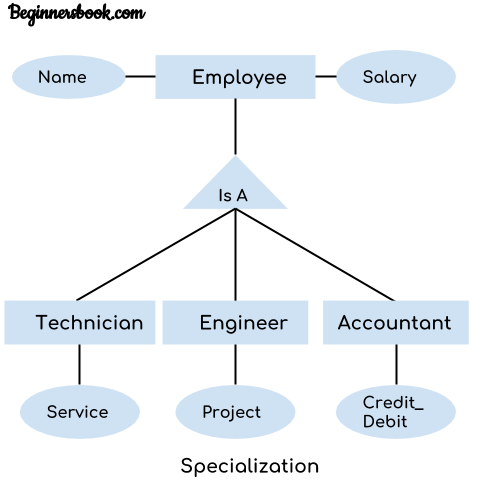
In the above diagram, we can see that we have a higher level entity “Employee” which we have divided in sub entities “Technician”, “Engineer” & “Accountant”. All of these are just an employee of a company, however their role is completely different and they have few different attributes. Just for the example, I have shown that Technician handles service requests, Engineer works on a project and Accountant handles the credit & debit details. All of these three employee types have few attributes common such as name & salary which we had left associated with the parent entity “Employee” as shown in the above diagram.